Are Bitcoin ATMs Safe? How to Use One Safely and Spot Scams
By Bitstop
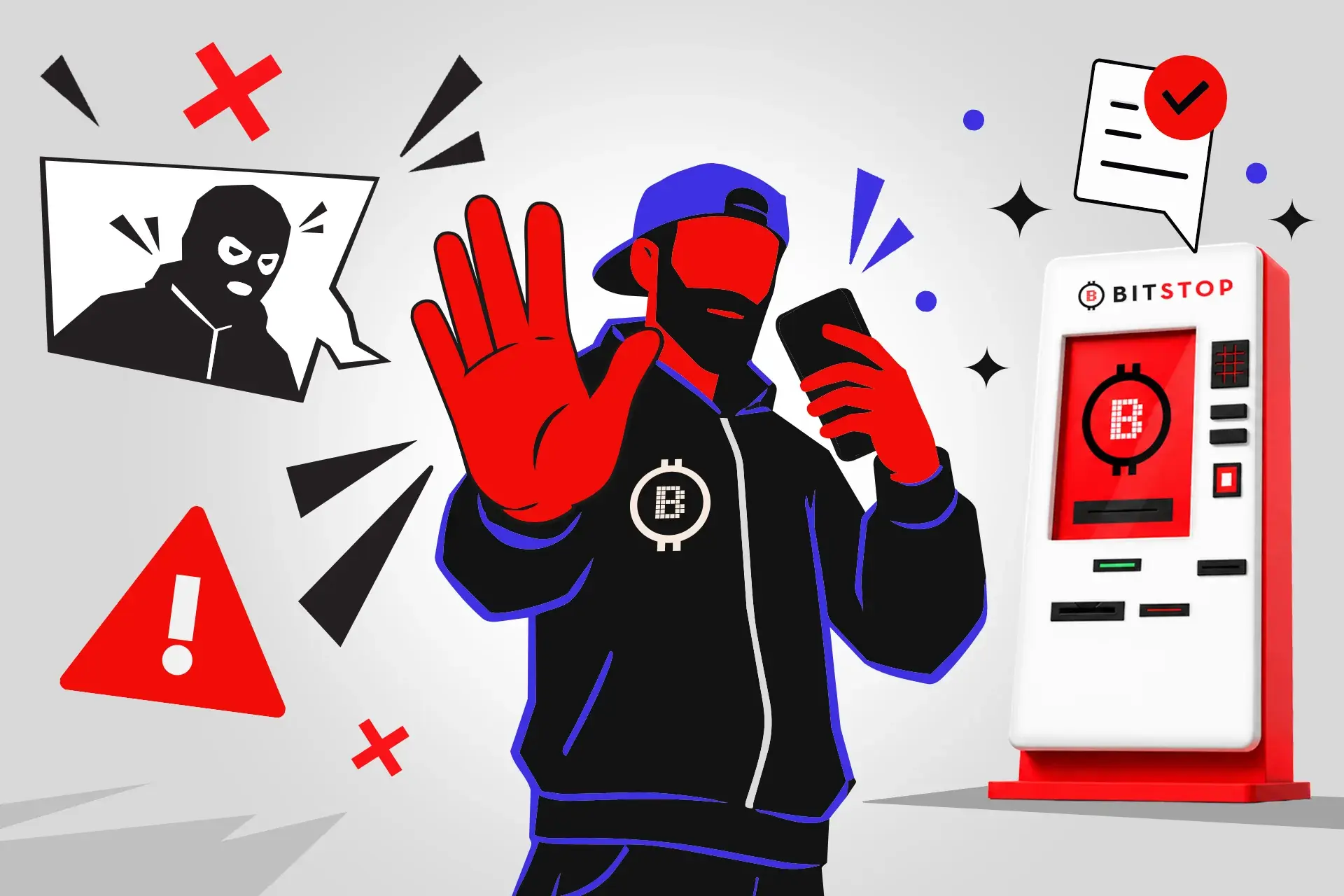
Yes. A Bitcoin ATM is safe to use when you send crypto to your own wallet, buy from a registered operator, and check the price on screen before you insert cash. The real danger is scams, not the machine. If anyone tells you to bring cash to a Bitcoin ATM and send it to a wallet or QR code they gave you, it's a scam, and because crypto transactions are final, that one rule protects you more than anything else.
Why scammers target Bitcoin ATMs
Scams don't start at the ATM. They start days or weeks earlier, with a phone call, a pop-up or a new online friend. The scammer builds trust and urgency, then sends the victim to a Bitcoin ATM as the last step, because a crypto payment can't be pulled back once it confirms.
The stakes are high. Americans reported losing $12.5 billion to fraud in 2024 (FTC), and people 60 and older reported $4.9 billion in losses (FBI IC3). Those figures cover all fraud, not just Bitcoin ATMs.
The red flags
No legitimate business, government agency, court, utility company or police officer will ever ask you to pay with Bitcoin or crypto. Stop if you hear any of these:
- "You owe the IRS / Social Security / the court." Government impersonation is the most common script.
- "Your power will be shut off today." Real utilities send written notices and take normal payments.
- "Your computer is infected. Pay for the repair in Bitcoin." Real tech support doesn't take crypto.
- "I need help, send Bitcoin." Romance scammers build a relationship online first, often for weeks.
- "Guaranteed returns" or "we'll double your crypto." Legitimate opportunities never begin at a cash machine.
- Someone stays on the phone and tells you what to press. Hang up.
Bitstop keeps the full list of scam scripts current. Read Watch Out for Scams and the fraud prevention page.
How to use a Bitcoin ATM safely: a checklist
- Use your own wallet. Scan the "Receive" QR code from a wallet app you installed yourself, such as Exodus, Trust Wallet or MetaMask. Never scan a code someone sent you. See choosing a wallet.
- Go alone and off the phone. If someone is coaching you through the purchase, stop.
- Know who runs the machine. The operator is named on the machine's help screen and on your receipt. Here's how to tell if you're at a Bitstop ATM.
- Check the price before any cash goes in. At a Bitstop ATM, the rate and fee show on screen before your first bill, then on your receipt and in your account history. Here's how Bitcoin ATM fees work.
- Read the warnings. Bitstop's scam warnings ask direct questions. Answer them honestly. They exist to catch a scam in progress.
- Keep your receipt. Its transaction ID is how you, and support, track the purchase.
- Use only official coupon codes. Redeem codes only from bitstop.co, the Bitstop app, verified Bitstop social accounts, official Bitstop email and authorized partners.
Some Bitstop ATMs are run by independent operators who license Bitstop's software. At those machines, the operator sets the rate and fee. The operator is named on the help screen, your receipt, and the ATM map.
New to the machines? Walk through how to use a Bitcoin ATM for the first time before you go.
Are Bitcoin ATMs legal and regulated in the US?
Yes. Federal rules treat a Bitcoin ATM operator as a money transmitter. FinCEN's 2019 guidance (FIN-2019-G001, section 4.3) says anyone who owns and operates an electronic terminal that takes cash and sends crypto must follow the rules for money transmitters. In practice, that means an operator must:
- Register with FinCEN as a money services business (MSB).
- Run an anti-money-laundering program, including identity checks, recordkeeping, transaction monitoring and suspicious-activity reporting.
States add their own layer. Operators can also need state money transmitter licenses, and ID requirements and daily limits vary by state. Several states also cap Bitcoin ATM fees or daily purchase amounts by law. Wherever you are, a compliant machine tells you when it needs your ID.
You can check an operator yourself. FinCEN's MSB Registrant Search lists registered money services businesses, and NMLS Consumer Access shows state licenses by company or NMLS ID.
How to tell which Bitcoin ATM operators are trustworthy
Trust the operators that can prove it. Here's what to check, and where Bitstop stands on each:
| What to check | Why it matters | Bitstop |
|---|---|---|
| FinCEN MSB registration | Required by federal rules for Bitcoin ATM operators | Registered MSB (operating company ATM OPS INC) |
| State licensing | States license money transmitters, and the rules vary by state | Licensed in every state where it operates. NMLS ID 1833409. |
| Price before cash | You should never learn the price after you pay | Rate and fee on screen before your first bill, then on the receipt and in account history |
| On-screen scam warnings | Interrupts a scam at the last possible moment | Warnings you must acknowledge before and during a purchase |
| Monitoring and human review | Catches patterns one warning can't | Real-time monitoring; high-risk purchases reviewed by a person |
| A way to pause a purchase | Gives a victim time to stop | Flagged purchases can be held before settlement |
| Support you can reach | Speed matters when a scam is in progress | 24/7 at (855) 524-8786 and support@bitstop.co |
| The operator named on your receipt | You know who to call | Operator named on the help screen, receipt and ATM map |
At an independently operated ATM on the Bitstop network, the operator, not Bitstop, holds the registrations and licenses for that machine and handles its compliance and refunds.
What Bitstop does to stop scams
Bitstop steps in at the machine, while a purchase can still be stopped:
- On-screen intervention. Fraud warnings and targeted questions appear before any purchase completes. You can't skip them without actively acknowledging them.
- Real-time monitoring. Every purchase is checked for fraud patterns, such as unusual amounts, repeat trips to the same machine, or matches with fraud intelligence reports. Bitstop's team may call you to confirm a purchase before it processes.
- Human review and holds. Flagged purchases go to Bitstop's compliance team, and settlement can be delayed. If a purchase is paused, the Bitstop app lets you complete it or cancel it for a refund. Here's why a transaction gets paused.
- Identity and sanctions checks. KYC and anti-money-laundering procedures apply above set thresholds, and every purchase is screened against OFAC sanctions lists.
The details of Bitstop's compliance program are in the Fraud Prevention & Compliance guide.
If you think you've been scammed
Act fast. The sooner you call, the better the chance of stopping a purchase.
- Call Bitstop support, 24/7: (855) 524-8786 or support@bitstop.co. Have your receipt or transaction ID ready.
- If the purchase is paused in your app, choose the refund option.
- Report it to the FTC at reportfraud.ftc.gov and the FBI at ic3.gov.
- If you or someone you know is 60 or older, call the DOJ Elder Fraud Hotline at (833) 372-8311.
It's not your fault. Scammers are professionals who work from scripts.
Find a Bitstop ATM near you on the locations map, or download the Bitstop app to register ahead and manage paused purchases.
Sources
- FinCEN, "Application of FinCEN's Regulations to Certain Business Models Involving Convertible Virtual Currencies," FIN-2019-G001, May 9, 2019, sections 3 and 4.3.
- Federal Trade Commission, "New FTC Data Show a Big Jump in Reported Losses to Fraud to $12.5 Billion in 2024," March 10, 2025.
- FBI Internet Crime Complaint Center, 2024 IC3 Report, losses by age group (60+: 147,127 complaints, $4.9 billion), p. 8.
- Bitstop compliance facts: bitstop.co/fraud-prevention and Fraud Prevention & Compliance, September 2026.
FAQ
Is it safe to use a Bitcoin ATM?
Yes, if you send crypto only to your own wallet, use a registered operator, and check the price on screen before you insert cash. The risk comes from scammers who pressure people into sending crypto to wallets they control.
How do I avoid Bitcoin ATM scams?
Follow one rule: never send crypto to a wallet or QR code someone else gave you. No government agency, utility, bank or legitimate business asks for payment at a Bitcoin ATM. If someone on the phone is telling you what to press, hang up.
Which Bitcoin ATM companies are the most trustworthy?
Look for FinCEN MSB registration, state licenses, the full price on screen before you pay, on-screen scam warnings, the ability to pause suspicious purchases, and 24/7 support. Bitstop, founded in 2013, is a FinCEN-registered MSB (ATM OPS INC, NMLS ID 1833409) with each of these protections.
Are Bitcoin ATMs legal in the US?
Yes. Federal rules treat Bitcoin ATM operators as money transmitters, which must register with FinCEN and run anti-money-laundering programs. States add licensing, and some cap fees or daily amounts.
Can a Bitcoin ATM transaction be reversed?
Not once it confirms on the blockchain. That's why Bitstop can hold flagged purchases before settlement. If you've been pressured into a purchase, call Bitstop support at (855) 524-8786 right away.
Why did the ATM ask me so many questions?
Scam-prevention questions interrupt the most common fraud scripts. If the questions describe your situation, such as someone on the phone telling you to pay, stop the purchase.
Bitstop provides access to digital assets. Nothing here is investment advice, a price prediction, or a guarantee of value. Digital asset transactions are subject to identity verification, AML procedures, and OFAC sanctions screening. Availability, eligibility, and limits vary by state. This article is general information, not legal advice.